
Research Ethics Committees (RECs) are a fundamental cornerstone in the overall process of governance of health research and play a vital role in protecting research participants, host institutions and researchers by ensuring research abides to high-quality ethical standards.
We are seeking expressions of interest from individuals who would like to contribute their expertise, experience, or public perspective to this important work.
- What are Reference RECs for HSE Regions
- Who Can Apply?
- Why join a HSE Reference Research Ethics Committee?
- What will you gain?
- What is expected?
- Frequently Asked Questions
What are Reference RECs for HSE Regions
Reference Research Ethics Committees (RRECs) for HSE Health Regions are Research Ethics Committees that were appointed by the National RGMS Committee for their region. These RECS are of significant importance to the Research community and to the HSE. They will all operate to the same Standard Code of Governance and Management and are supported in their operations by the National HSE Support and Coordination Office (SCO).
Committees review applications for research approval and are made up of volunteer members who kindly give their time to make a difference and ensure that Health Research conducted in Ireland is to the highest ethical standards. The RREC members are a mixture of experts (registered healthcare professionals, clinical trial experts, statisticians and other experts in research) and lay members with an interest in health research ethics.
The primary role of the RRECs is to protect the welfare and the rights of research participants in accordance with recognised ethical principles and standards, relevant EU Directives and Regulations, national legislation, and alignment with the HSE National Framework for the Governance, Management and Support of Research (RGMS) and other relevant policies.
Who Can Apply?
Our RRECs are made up of a variety of people who bring different skills and experiences. Some members have experience of working in healthcare and social care, and some have no experience at all.
Expert members: We are seeking individuals with professional expertise and experience in areas relevant to health and social care research. This may include expertise in healthcare, research, pharmacy, academia, law, ethics, data protection, statistics, artificial intelligence, or other relevant fields. Expert members contribute their knowledge to help ensure that research is scientifically sound, ethically robust and conducted in line with relevant standards and regulations
- Healthcare professionals
- Researchers
- Academics
- Pharmacists
- Legal professionals
- Ethicists
- Data protection specialists
- Statisticians
- Artificial Intelligence Specialists
Public and Patient members: We are equally committed to recruiting patient and public representatives. Public and Patient members bring the perspective of patients, service users, carers and the wider public. They help ensure that research is understandable, respectful and relevant to the people and communities it is intended to benefit. No previous experience of research ethics committees is required. Their role is to provide an independent public perspective and help keep the rights, experiences and interests of research participants at the centre of decision-making.
- Have lived experience as patients, service users, carers or advocates
- Are interested in supporting ethical research
- Can bring a community or public perspective
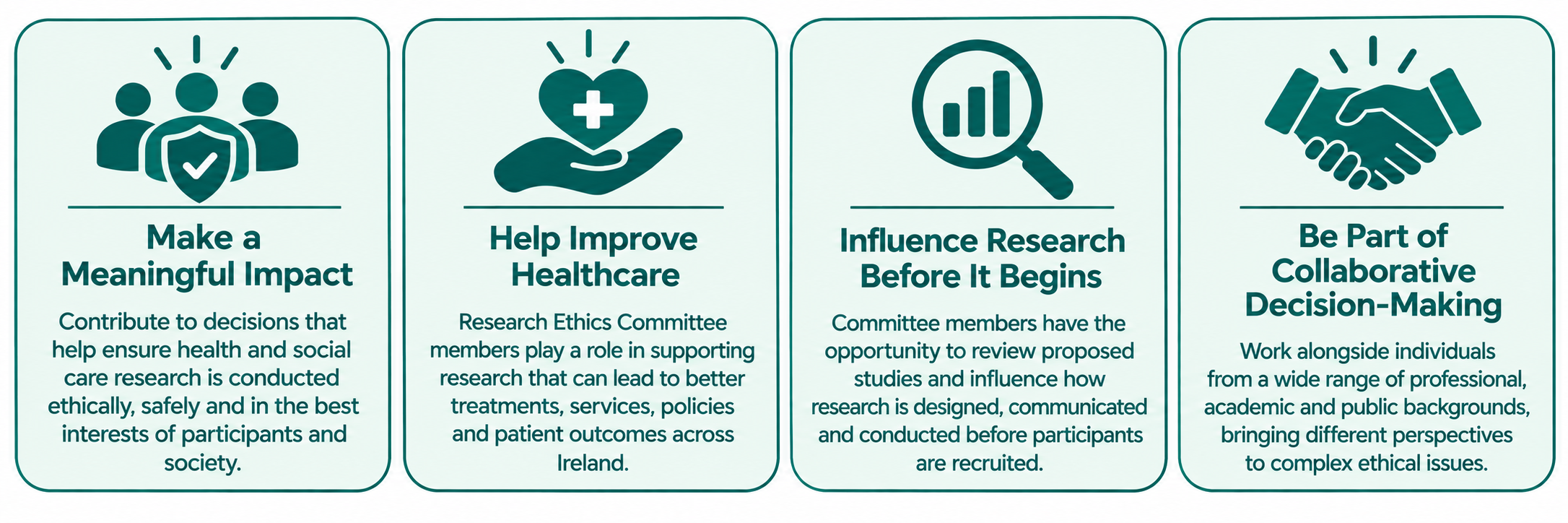
Why join a Reference Research Ethics Committee for a HSE Region?
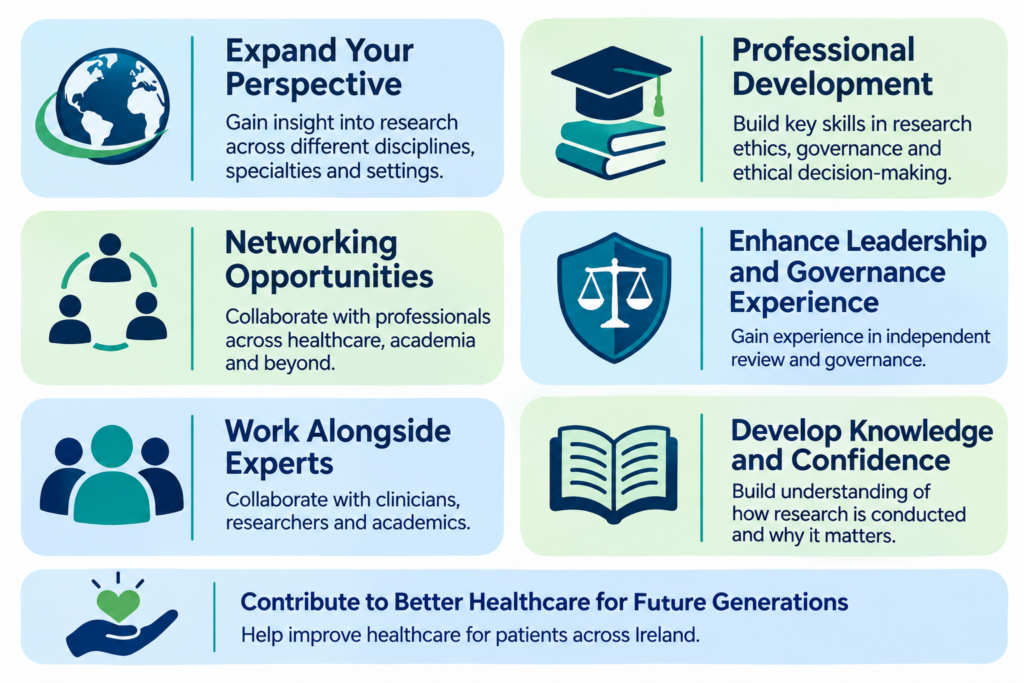
What will you gain?
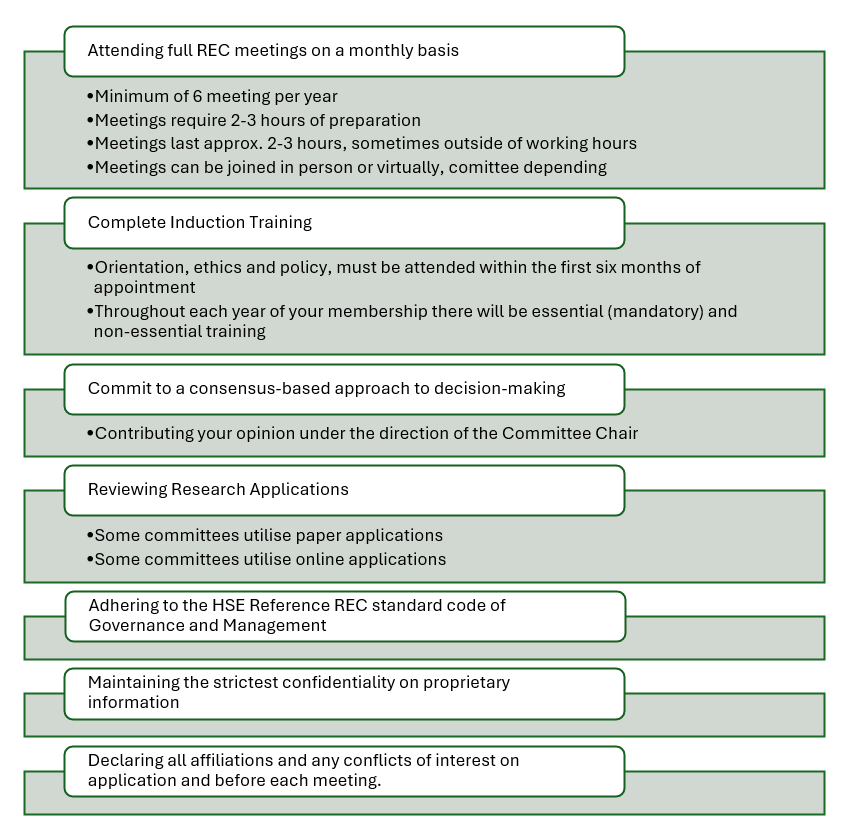
What is expected?
Membership of a Reference REC is an important role and does require commitment. Members will be responsible for contributing to protecting the welfare and the rights of research participants in accordance with recognised ethical principles and standards of relevant legislation.
They will also be part of a group that ensures that the HSE Reference RECs protect the host institutions, their staff and researchers by ensuring research abides to high-quality ethical standards.
Reference REC members are volunteers and receive no payment for contributing to the review of applications at scheduled meetings or for attending such meetings. For those who work in healthcare settings (in any capacity), prior to making an application to be on a Reference REC, please ensure that your line manager is aware and supports your application.
Committee membership can also contribute to professional development goals and may be recognised by employers as a valuable opportunity to gain experience in governance, ethical review and multidisciplinary decision-making. Applicants are encouraged to discuss potential support arrangements with their employer where appropriate and explore acquiring Continuous Profession Development (CPD) points by attending REC meetings.
We need members who can commit to:
FAQs
What experience should I have?
Our committees benefit from the knowledge, experiences and viewpoints of people from many different backgrounds. You do not need any previous experience serving on a committee. Whether your experience comes from your professional life, community involvement, voluntary work, advocacy, education or lived experience, your contribution can make a valuable difference. We provide training and ongoing support to help you succeed in the role.
How much time is involved?
We ask our members to commit to 2 to 3 hours per month for each REC meeting, plus and additional 2 to 3 hours reading in preparation for each meeting. There are usually 10 meetings of each committee each year, and we ask all members to commit to attending at least 6 of these.
Will I be able to carry out the role of a REC member alongside my current job?
Participation in a Research Ethics Committee provides a valuable opportunity to contribute to the governance and oversight of health and social care research in Ireland. Many employers recognise committee membership as a form of professional development and may support employees through flexible working arrangements or other workplace policies. Applicants are encouraged to discuss the time commitment with their employer to determine what support may be available.
Many committee meetings are held during normal working hours, although some meetings may take place in the evening.
Will I get paid for being a REC member?
Membership in a REC is on a voluntary basis, members receive no payment for the role.
Can I talk to someone before deciding to apply?
Yes! Email research.sco@hse.ie and one of our team members will assist you in arrange a meeting to answer your queries before deciding to apply.
How do I apply?
Please complete the Expression of Interest from available here, and email Research.SCO@hse.ie
updated 22/05/26